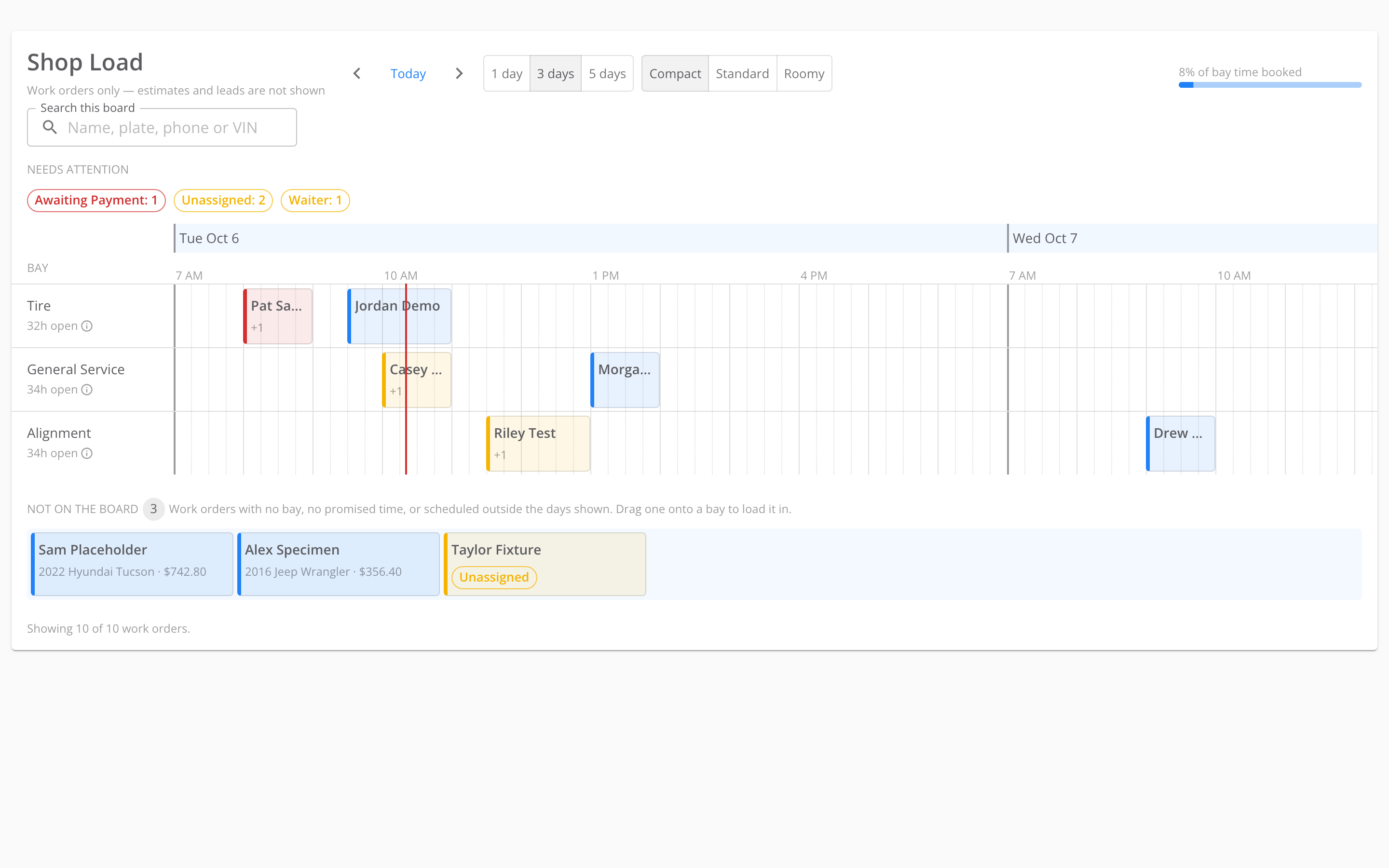
See every open work order by bay and time, and drag each job into place as work moves through your store.
Shop Load lays your open work orders out on a time grid, one row for each bay. Think of the strip along the bottom as the stack of printed work orders in sleeves on your counter. As each job moves into a bay, drag its card into that bay and the time it starts.
Shop Load uses your store’s service categories as its bays, so it needs at least one set up. See Set up your bays.
The board shows the store you have open. To see another store, change the store at the top of the page.
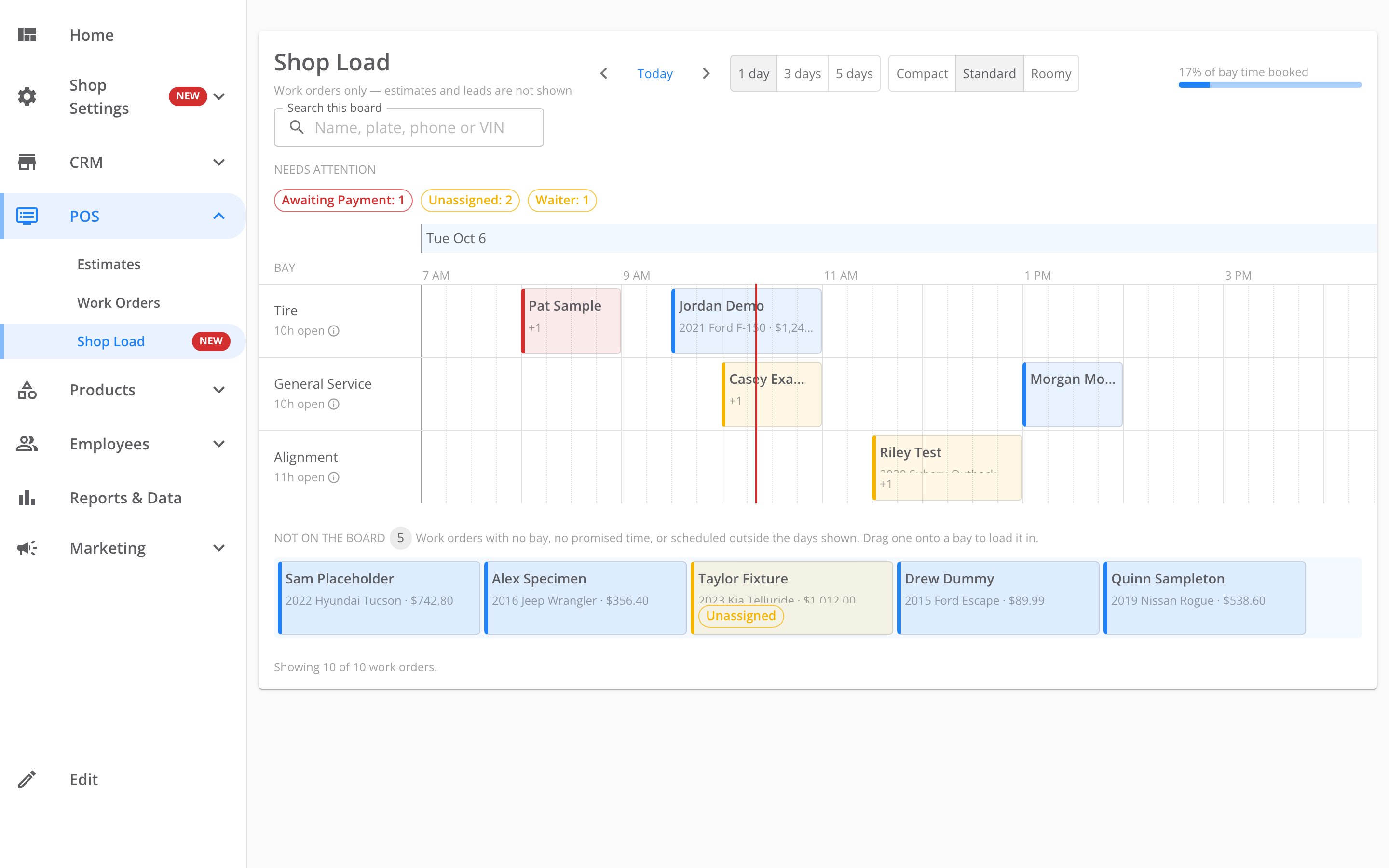
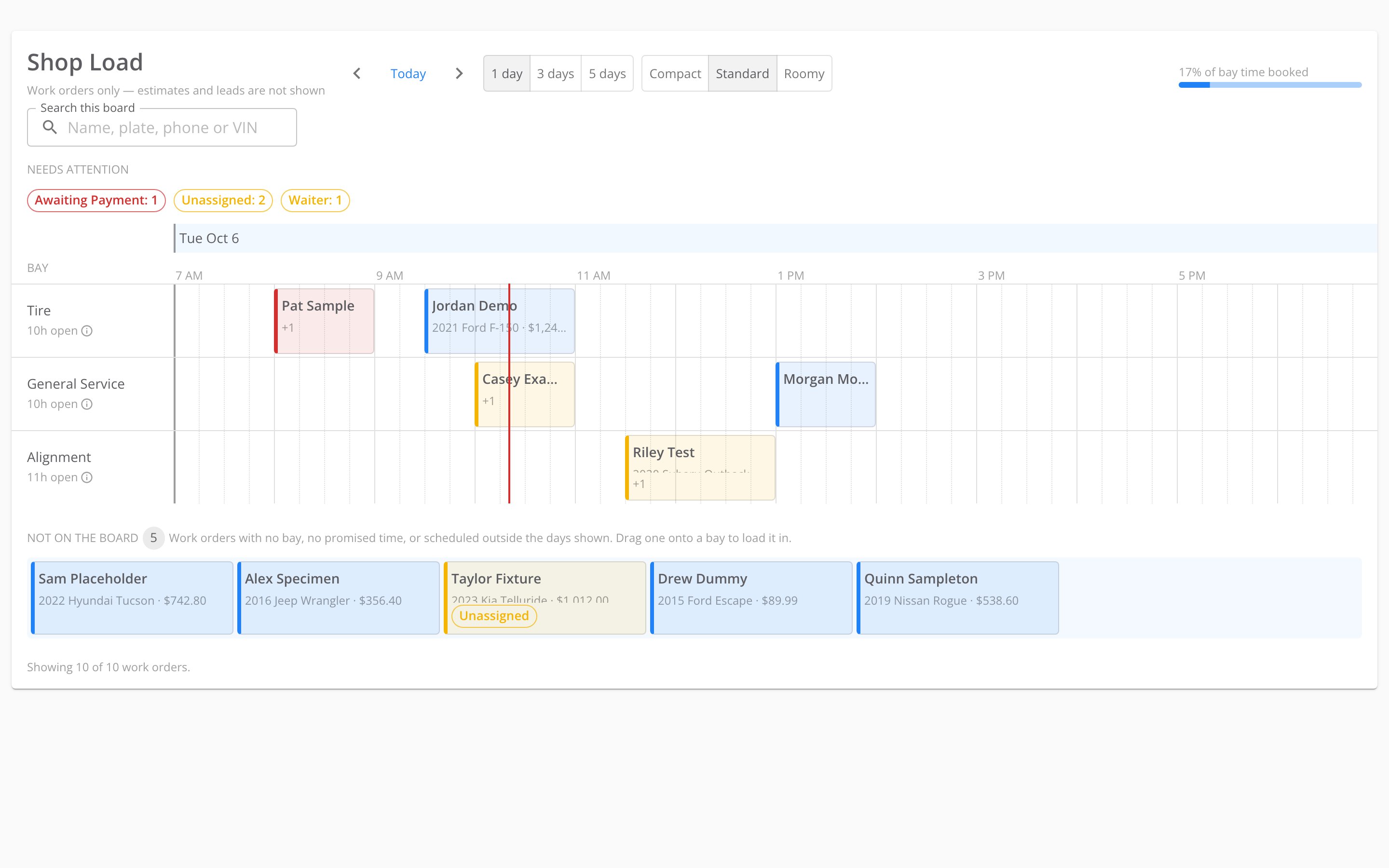
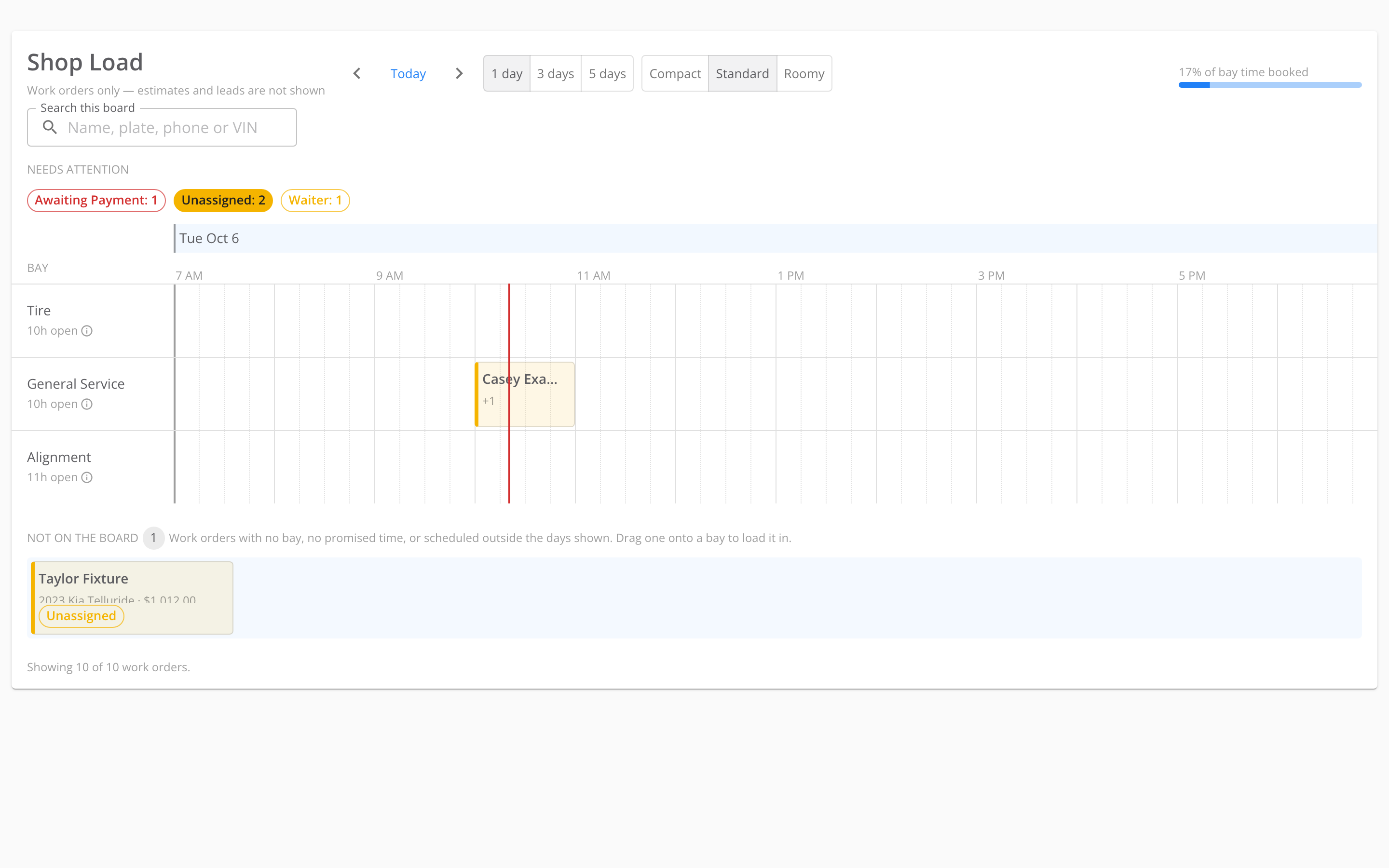
One day on Shop Load. Each row is a bay, and the strip at the bottom holds jobs not on the board yet.
Bays. Each row is one bay, named after a service category: Tire, General Service or Alignment.
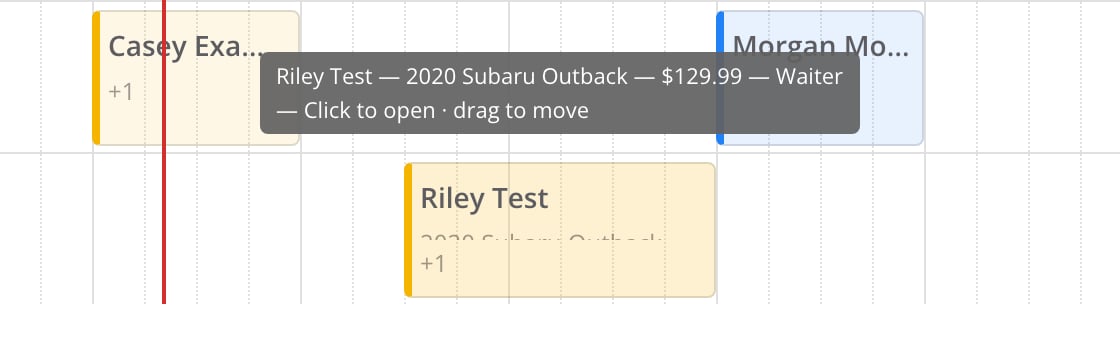
Cards. A card shows the customer’s name, the vehicle and the work order total. A tag is a short label below them, such as Unassigned, that flags what needs attention. A +1 means the card has one more tag than it has room for. Hover over the card to see it.
Not on the board. The strip at the bottom holds work orders with no bay, no promised time, or a time outside the days on screen.
Your bays are your store’s service categories. Set them up under Settings › Organization › Service Categories. If you cannot find that page, contact support.You need Admin or Owner access to the store to change service categories. Once you add a service category, you cannot remove it.A store can have each service category once, so the board shows up to three bays.
A store with no service categories sees this message instead of the board.
The message says to add bays in shop settings. The page you need is Service Categories.
Load a job when it goes into a bay, or when you promise the customer a time.
1
Find the job
Find its card in the Not on the board strip. The strip shows 12 cards at a time. Select Show more to see the rest.
The Not on the board strip. Each card is a work order waiting for a bay.
2
Drag it to its bay
Drag the card into the row for the bay the job goes in.
3
Drop it on the start time
Drop the card on the time the work starts.
The card stays where you drop it, and the work order takes that bay and that start time. The start time is the start of the 15-minute slot you dropped it on.A card’s length is the job’s appointment length. Without one, it uses the labor hours on the work order. Without those, it takes 60 minutes.
Drag the card to the new bay, the new time, or both.The job takes the start time of the slot you drop it on. To keep a job’s start time while you move it to another bay, drop it in the same time column.You cannot drag a card back into the Not on the board strip.
Open time. Under each bay’s name, a figure such as 10h open shows the unbooked time in that bay across the days on screen.
Booked time. The bar at the top right shows the share of bay time that has work in it, such as 17% of bay time booked. That means jobs fill 17 of every 100 bookable minutes across your bays. The bar turns red above 90%.
The day. The grid runs from 7 AM to 7 PM in 15-minute slots. A red line marks the current time.
Type in Search this board to find a job by customer name, license plate, phone number or VIN.The Needs attention chips count the jobs carrying each tag. Select a chip to show only those jobs. Select the same chip again to see every job.If no job matches, the board says No work orders match these filters. Select Clear filters in that message.
The Unassigned chip is selected, so the board shows only the two jobs with no technician.
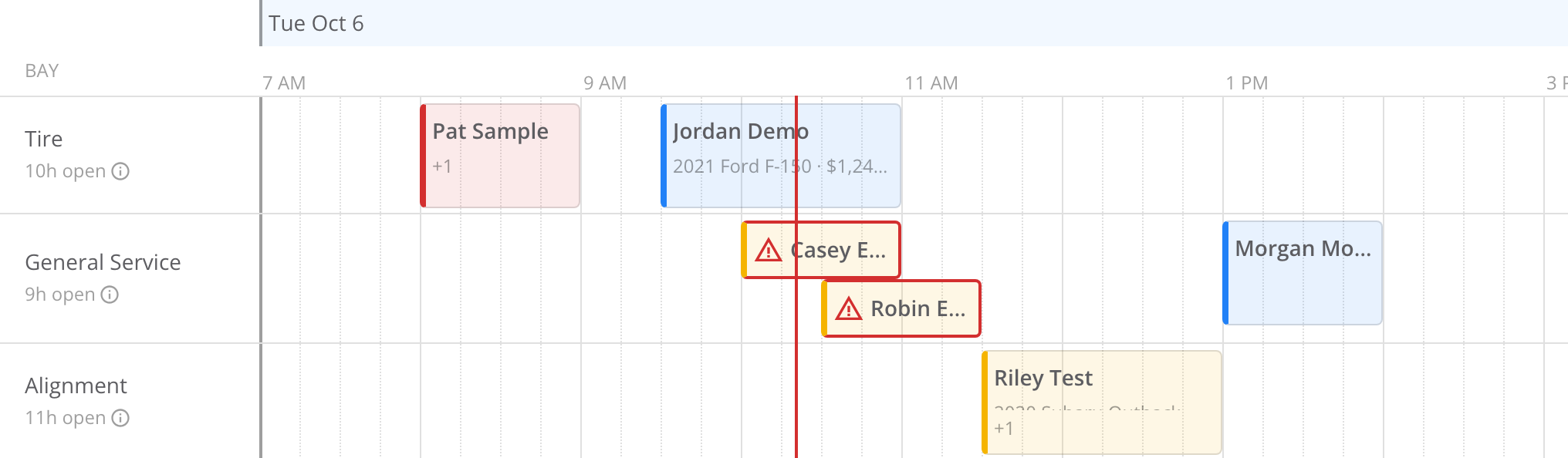
Shop Load shows work orders only. Estimates and leads do not appear.A work order stays on the board until it is complete and paid. A payment for the full amount completes the work order, so the job leaves the board. A work order with a partial payment stays.The board loads up to 200 work orders. A store with more sees a message above the board that starts Showing only X of Y work orders. When you see it, the open time, the booked share and the double-booking warnings count only the jobs the board loaded.
Fixed hours. The grid always runs from 7 AM to 7 PM. It does not use your store’s business hours.
Up to three bays. Each bay is a service category, so the board cannot show one row per lift or per technician.
No change of length on the board. To change a job’s length, open the scheduler. Drag the bottom edge of its block, or set the end time in Edit appointment. Shop Load uses the new length.
Online booking is separate. Your website’s booking calendar does not read Shop Load. A full bay does not stop a customer booking that time online.
Other screens refresh on reload. A move on Shop Load saves at once. The scheduler and other open screens show it the next time they load.
If a move does not save, a message tells you which part saved. For example: Only the time change saved — the bay change was not confirmed. The board then puts the card back where the work order says it is. Move the card again.If the message ends reload to see what is actually scheduled, reload the page before you move anything else.If the board says We could not load the shop load board. Please refresh to try again., reload the page. If it still does not load, contact support.